Hiking among apple blossoms
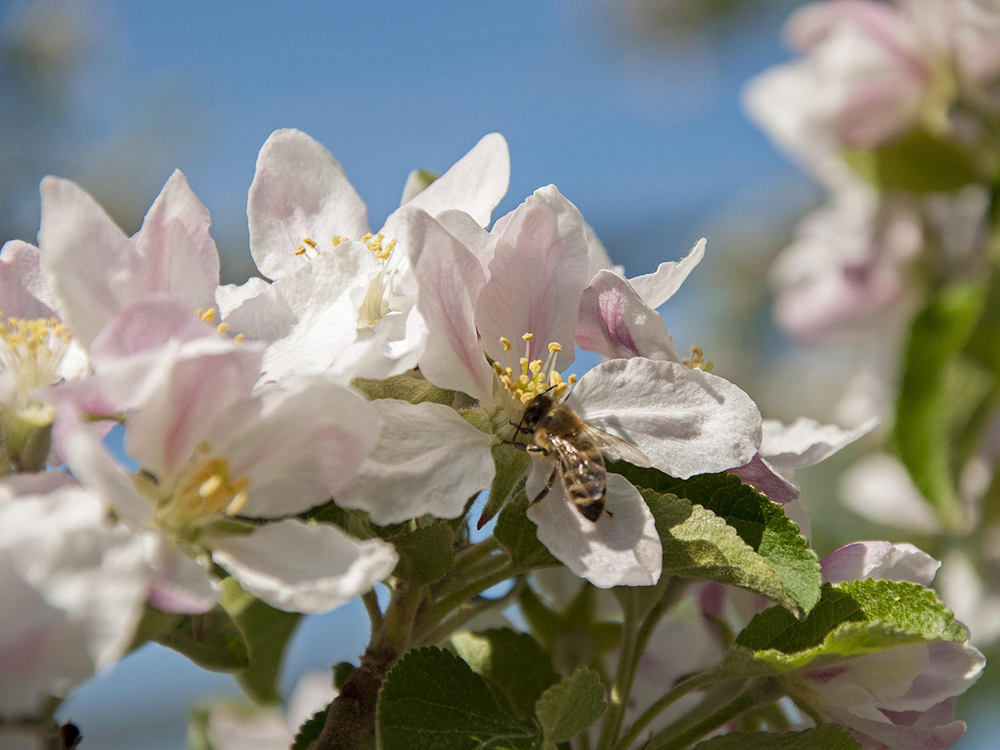
In spring, the Vinschgau (Italian: Val Venosta) turns into a sea of apple blossoms. While snow still lies higher up in this South Tyrolean valley, the apple orchards below are coloured white and soft pink. The contrast between winter and spring makes this period special.
Many people know the Vinschgau mainly for the church tower rising out of Lake Reschen, a photogenic remnant of the old village of Graun. But anyone travelling to this part of South Tyrol in April or early May will discover that the valley has more to offer than just that one iconic image. Spring is perhaps the most beautiful time of year here.
One of Europe's largest apple-growing regions
The Vinschgau Valley is one of Europe's largest apple-growing regions. The climate here is dry and the valley enjoys many hours of sunshine, which apples love. Due to the differences in altitude, there are slight variations in temperature, which means that flowering is spread over several weeks. Apple trees usually bloom from mid-April to early May, but this can vary from year to year. Farmers usually know when to expect the first flowers. If it has been a cold, dry winter, flowering usually starts a little later. If it has been a mild, wet winter, the blossoms appear a little earlier. A sunny and relatively warm spring promotes abundant flowering.
Frost
You may find the blossoms covered in a layer of ice. When night frost is forecast, farmers spray water over the trees. If it freezes at night, the water freezes, forming a layer of ice around the flowers. Underneath the ice, it stays warm, protecting the blossoms from further cooling down. A layer of ice protects against frost damage.
Waalwegen in South Tyrol
The best thing, of course, is to experience the apple blossom up close. To walk right past the beautifully coloured and wonderfully fragrant trees. From a distance, the pink and white slopes are a special sight. Especially with the still white mountain peaks in the background, but to really experience the blossom, you can walk the “waalwegen”. Waalwege are relatively flat paths that run alongside old irrigation channels. These channels were once used to channel water from the glaciers to the dry fields, including the apple orchards. They are a nostalgic reminder of the agriculture of the past and today are an ideal way to enjoy a peaceful walk and experience the apple blossom up close. The gentle murmur of the water in the Waal and the scent of blossoms make a spring walk here particularly pleasant.
What else can you do in the Vinschgau?
Those who travel to the Vinschgau in spring for the apple blossoms need not limit themselves to the orchards alone. The valley has a number of special sights that are well worth a visit.
At the beginning of the valley lies Lake Reschen, with its famous church tower rising out of the water. It is one of the most photographed places in South Tyrol. In spring, it is often quieter here than in summer, allowing you to experience the landscape in complete tranquillity.
A little further on is Schloss Juval, high above the valley. The castle not only offers views of the surrounding area, but also houses a museum dedicated to global mountain culture. Combined with a walk through the blossoming surroundings, this offers a wonderful combination of nature and culture.
Another special feature is the marble of Laas. The white marble from this part of South Tyrol has been quarried for centuries and has even been used for international buildings. Those interested in craftsmanship and history can learn more about this traditional industry here.
Easter in the Vinschgau
Those who stay in the Vinschgau around Easter will notice that spring is not only visible in the blossoming orchards. In many villages, traditional church services and processions are held in the week before Easter. Catholic customs are still strong in South Tyrol and give this period a subdued but festive atmosphere.
Easter is also part of spring in culinary terms. Sweet Easter breads appear in the bakeries and eggs are traditionally coloured. Together with the blossoming apple trees and the still white mountain peaks, this creates a special combination of nature and tradition. A visit to the Vinschgau around Easter therefore offers not only a landscape in bloom, but also an insight into local customs.
For those who want to escape the crowds and experience spring up close, the Vinschgau Valley is an ideal destination. The apple blossom transforms the valley into a unique landscape of white and soft pink, while the mountain peaks still bear a hint of winter. Along the Waalwegen, you can stroll peacefully past blossoming orchards, with views of snow-capped peaks and the gentle murmur of flowing water.
It is precisely in this transition between winter and summer that the Vinschgau Valley shows its most versatile side. It is a destination where nature, culture and tranquillity come together and where spring is not only visible but also tangible.